CAMINO DE SIRGA
OFFICIAL JACK RUSSELL TERRIER STANDARD
Below is an outline of the Official Jack Russell Terrier Standard. If you would like detailed and extensive information about the Jack Russell Terrier Standard, the Extended Jack Russell Terrier Standard, and its differences from the Parson Russell Terrier, click to go to the "More Information" section, where you will find the respective links and attached documents.
INTRODUCTION TO THE OFFICIAL JACK RUSSELL TERRIER STANDARD
The Jack Russell Terrier is a breed that combines the robustness and functionality of a working dog with the charisma of a household companion—something that has been appreciated for over a century.
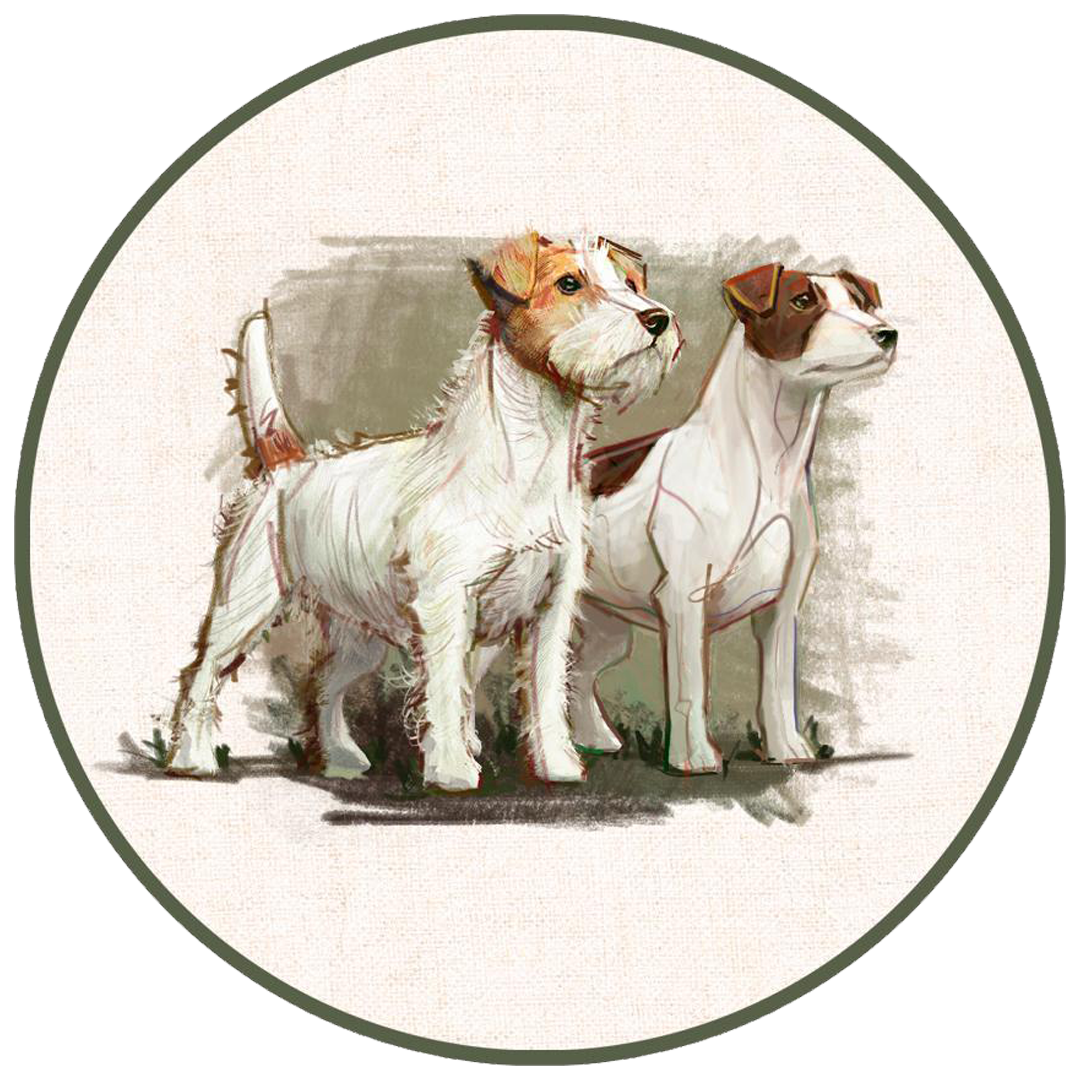
Regarding the official Jack Russell Terrier standard—featuring images and illustrations from the study conducted by Mrs. R.N. Francis-Little, as well as original photographs—and covering, among other essential aspects defining this iconic breed, origin, dimensions, weight, coat, character, pedigree, and health, we can summarize the following key points:
ORIGIN AND HISTORY OF THE JACK RUSSELL TERRIER

TRUMP – LA PRIMERA JACK RUSSELL TERRIER
The breed is named after Reverend John Russell, a clergyman and keen fox hunter who lived in southern England in the 19th century.
In fox hunting, terriers were not meant to kill the fox but to nip and provoke it so that it would leave its den and the chase could resume.
The terrier was carried in a sack by a mounted hunter and released at a certain distance to find its way back to the den. For this reason, it was insisted that they have predominantly white bodies, so that other hounds and hunting dogs would not mistake the terrier for the fox and kill it accidentally.
The goal was to develop a white terrier capable of running with hounds and entering burrows to flush out foxes. They were also used as exterminators of badgers, rats, and mice, among other vermin, and for hunting rabbits, otters, hares, ducks, and other small animals.
Through selective breeding—using the now-extinct Old White Terrier, the black terrier, and the Fox Terrier—the Jack Russell Terrier was born.
GENERAL APPEARANCE OF THE JACK RUSSELL TERRIER
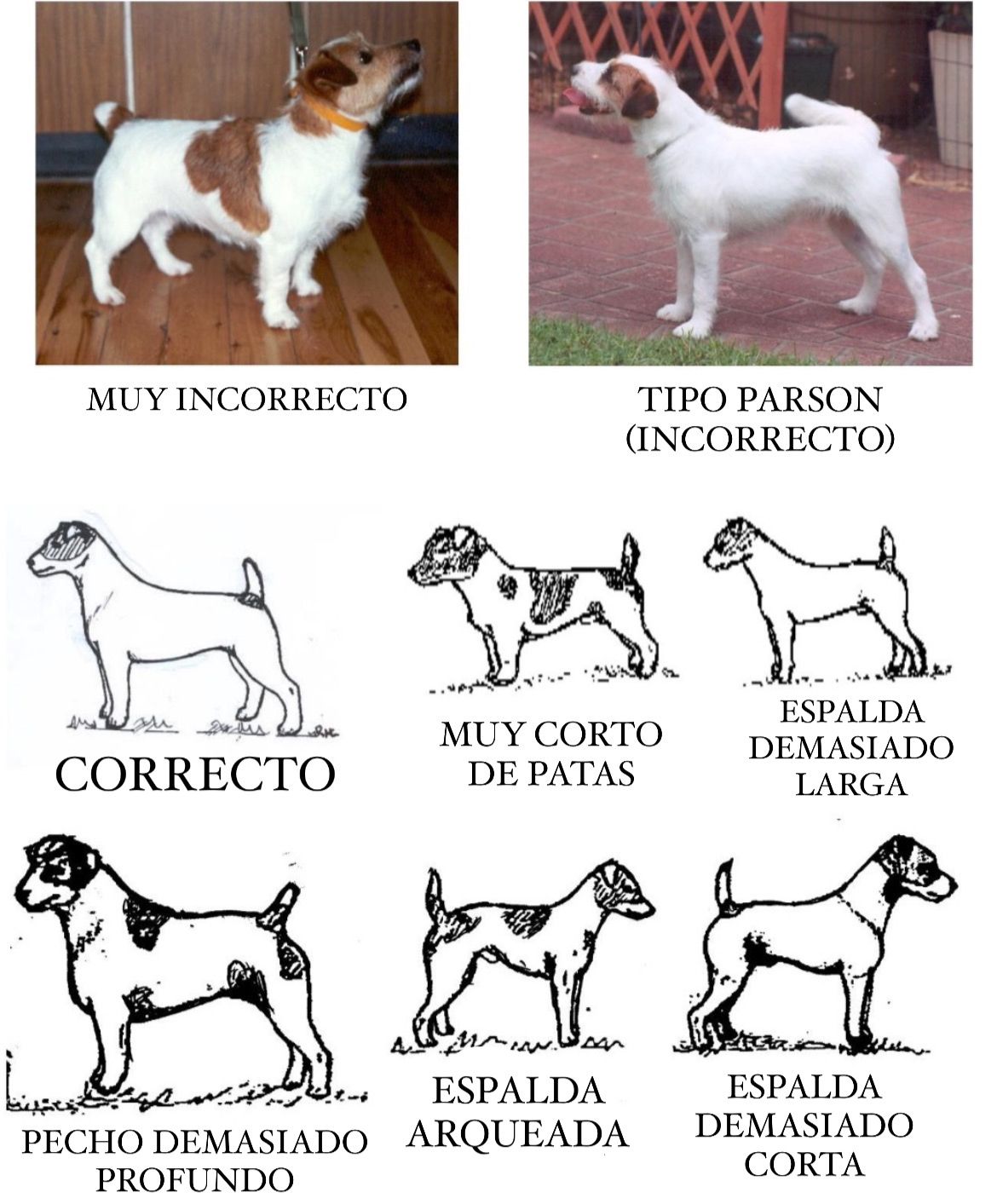
CORRECT INCORRECT
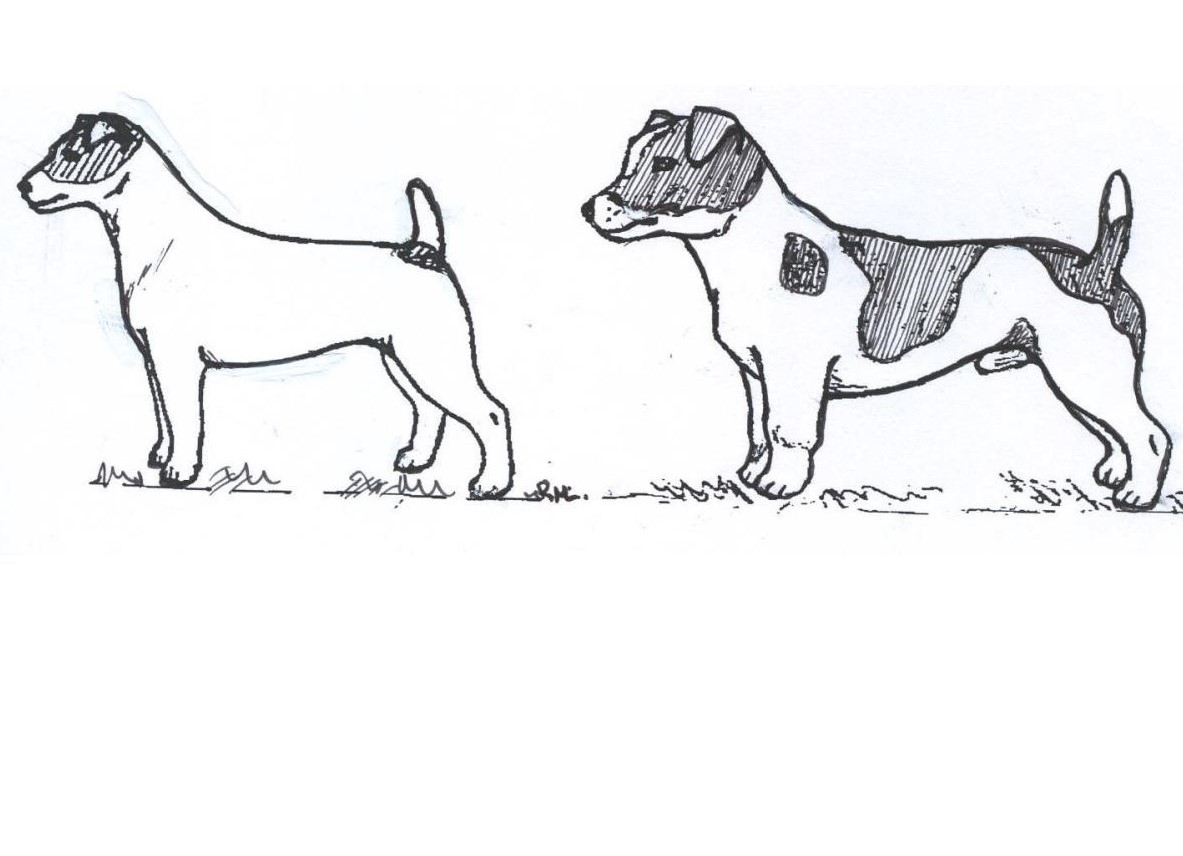
Agile and active, with a strong build reflecting its working dog origins. Its body is slightly longer than it is tall, and although sturdy, it should never appear heavy.
The sharp, intelligent expression—key to the Jack Russell—shows in the eyes, ears, and upright tail when moving. However, a hyperactive dog should not be prioritized over a calm, confident one, as activity does not necessarily indicate superiority in a terrier.
CHARACTER AND TEMPERAMENT OF THE JACK RUSSELL TERRIER
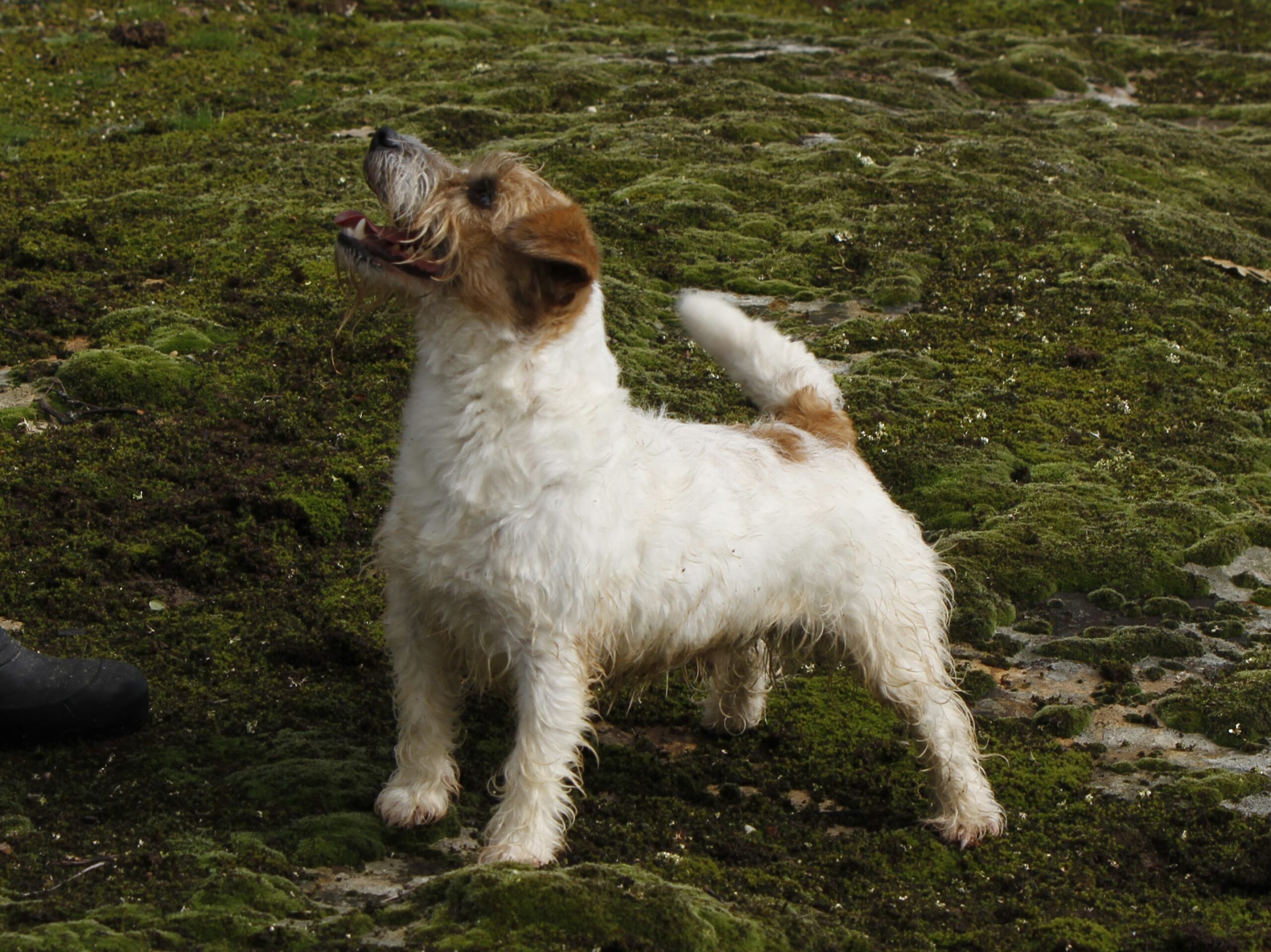
According to the Official Standard, the Jack Russell Terrier is known for its courage, energy, and friendly nature. The standard describes it as: "A lively, alert, and active terrier with a keen, intelligent expression. They are bold, friendly, and self-assured."
They are extremely loyal, sometimes stubborn, but always eager to please. Their ever-alert nature also makes them excellent watchdogs. Healthy, strong, and well-balanced in temperament, they are energetic, curious, and playful, with a strong hunting instinct.
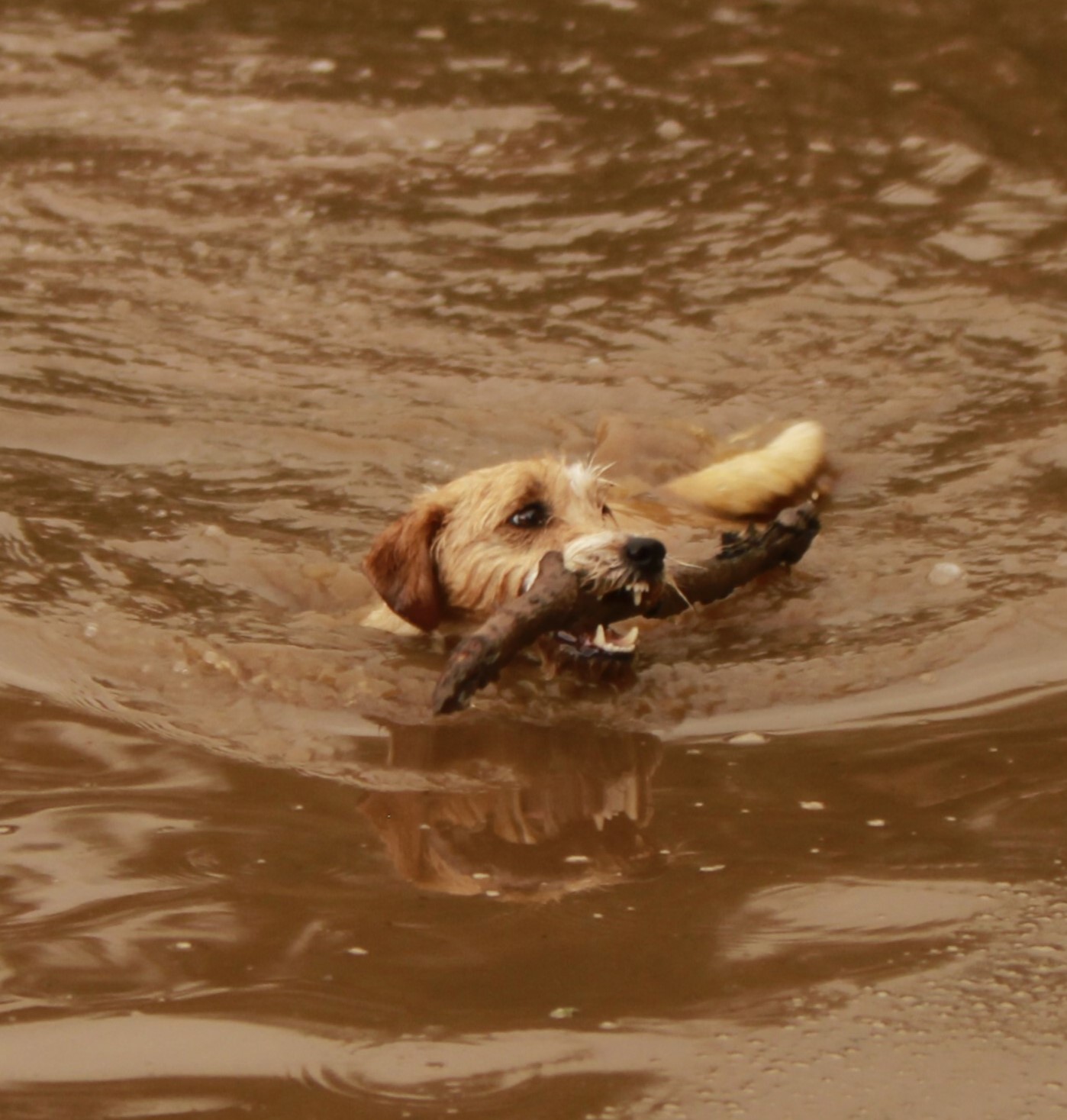
They need open spaces to exercise and satisfy their endless curiosity and vitality. To maximize their intelligence, they require consistent, patient training. They are not recommended for sedentary people or inexperienced dog owners. They excel in many activities, especially those that involve jumping, tracking, chasing prey, and digging—skills rooted in their hunting past. They have also succeeded as actors, contributing to their popularity thanks to their unmatched charisma.
DIMENSIONS AND WEIGHT OF THE JACK RUSSELL TERRIER
The robust appearance of the Jack Russell Terrier is well proportioned with its small but sturdy size:
• Height at the withers: Ideally, between 25 and 30 cm.
• Weight: Depends on the bone structure and the sex of the dog, but generally ranges between 6 and 8 kg.
The weight in kg is equivalent to 1 kg for every 5 cm of height, that is, a dog measuring 25 cm in height should weigh about 5 kg and a dog of 30 cm should weigh 6 kg. Although this is approximate, it will then depend on each individual dog.
It is a small dog, NOT short-legged, but well proportioned, with a body representing 50% and the legs the other 50% of the total height.


GOOD EXAMPLE
HEAD AND EXPRESSION OF THE JACK RUSSELL TERRIER
• Skull: Characterized by being flat and of moderate width, gradually tapering towards the eyes and muzzle.
• Stop (naso-frontal depression): Defined but not excessively pronounced.
CORRECT

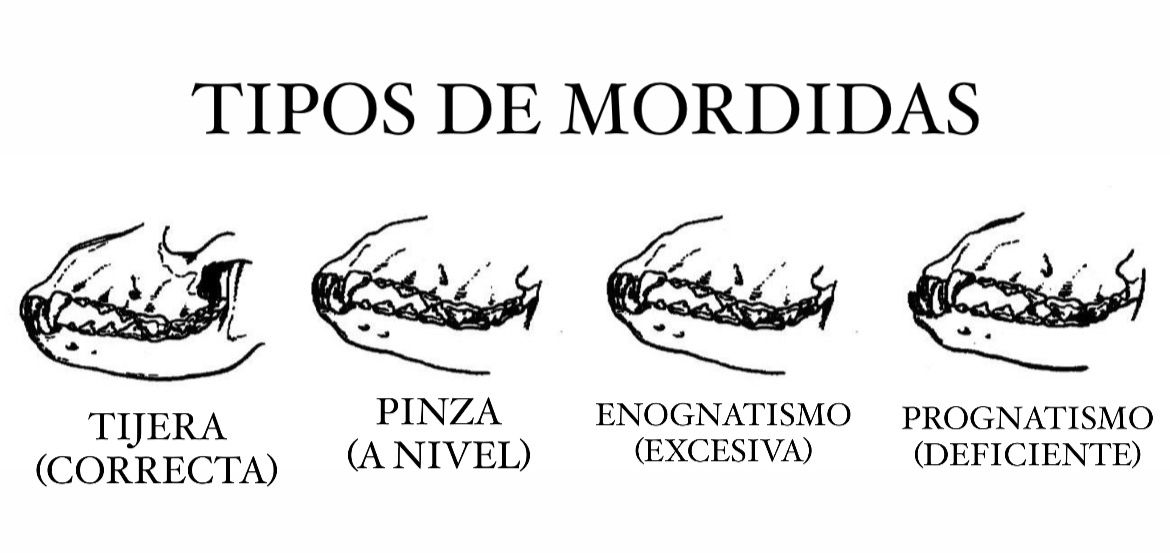
• Mouth: Deep, wide, and powerful jaws and strong teeth, approaching a scissor bite. It must always present “full dentition” and the jaws should look square. The lips are completely pigmented black, same as the nose.
• Muzzle: Straight and ending in a black nose.
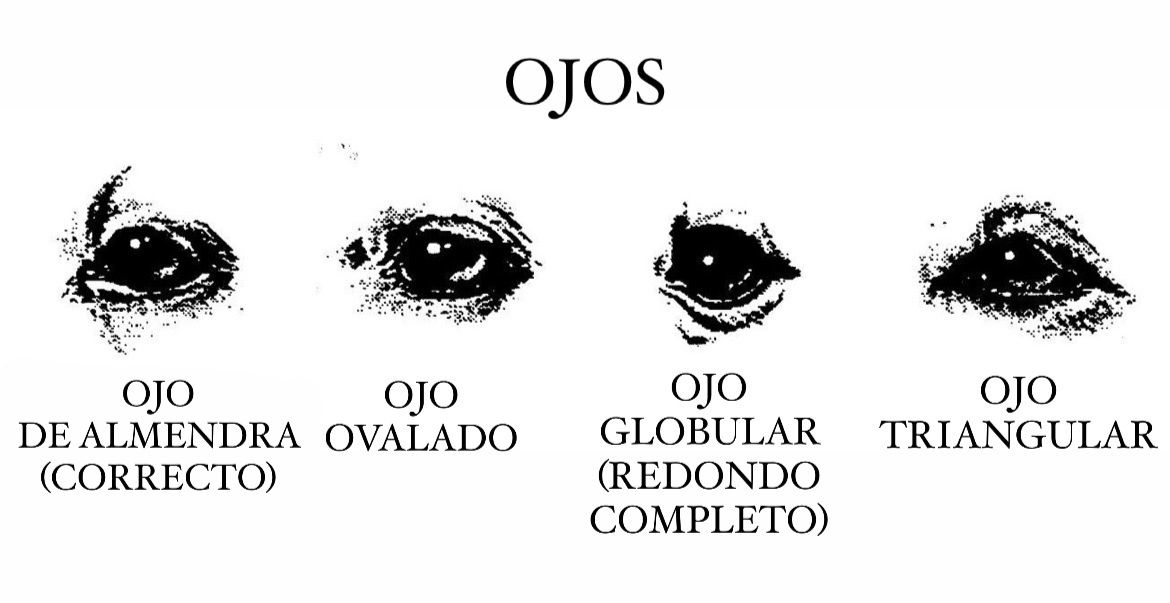
• Eyes: Medium-sized, almond-shaped, dark, with a lively and intelligent expression.
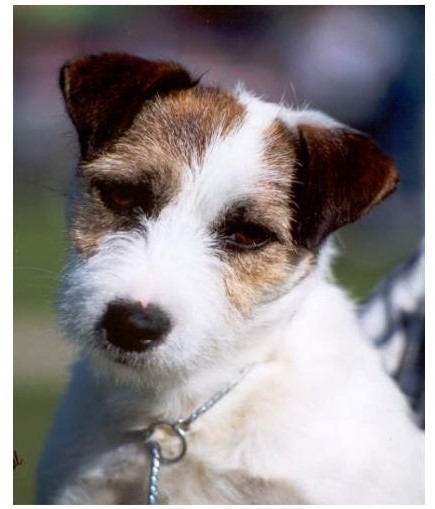
• Ears: These must be small, ‘V’-shaped, set high, and fall forward close to the cheeks.

BODY OF THE JACK RUSSELL TERRIER
According to the official standard of the Jack Russell Terrier, the compact body must reflect its sturdy nature:
• Neck: Medium length and muscular, gradually broadening towards the shoulders.
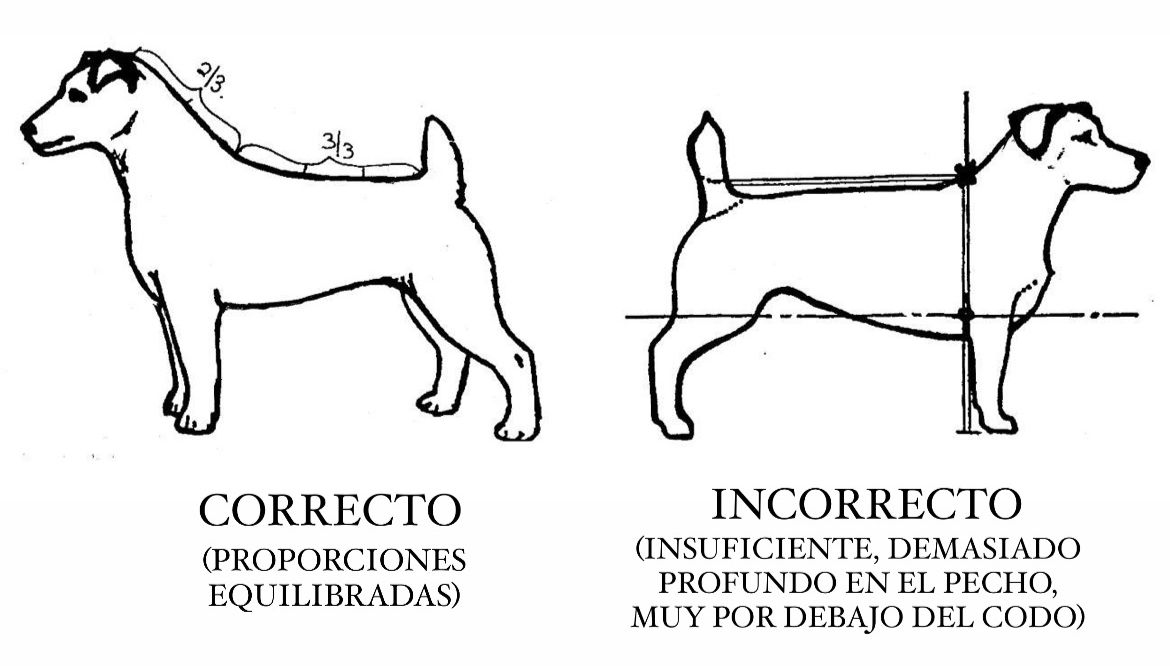
• Back: Straight and strong.
• Chest: Must be deep and moderately wide, providing space for a robust heart and lungs, essential for endurance.
• Ribs: Well arched and extending backwards.
• Loin: Short, strong, and flexible.
LIMBS OF THE JACK RUSSELL TERRIER
Designed for speed and agility:
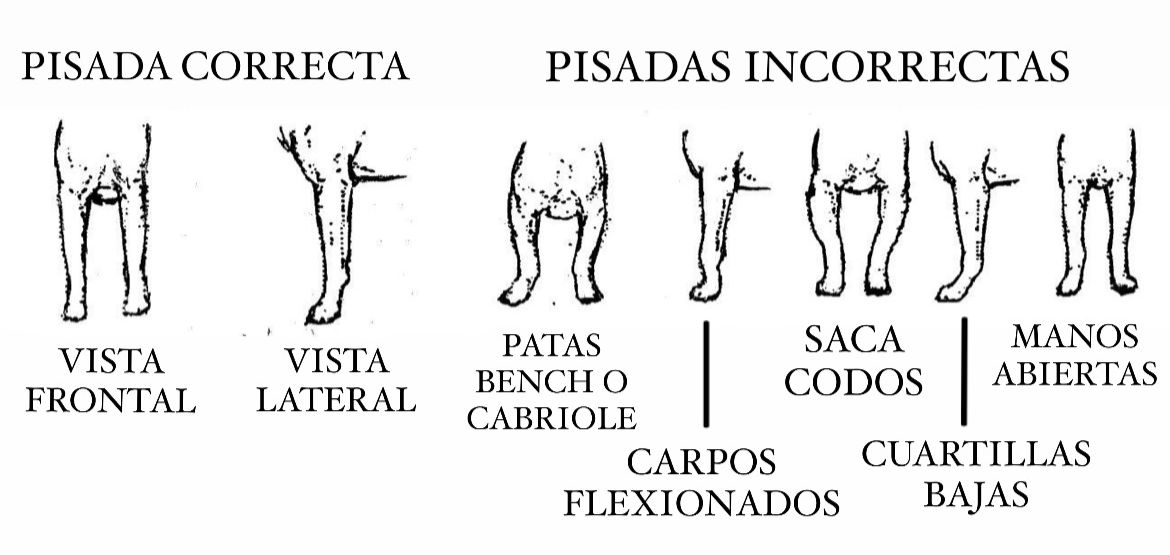
• Forequarters: Should be straight and strong, with good bone.
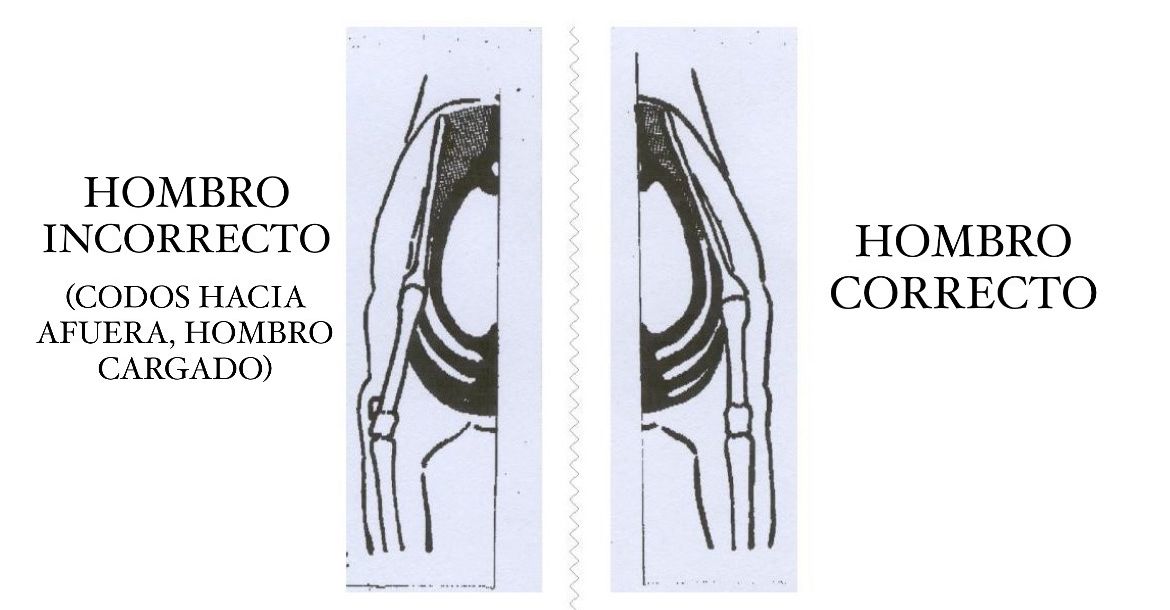
• Shoulders: Well sloped and set back.
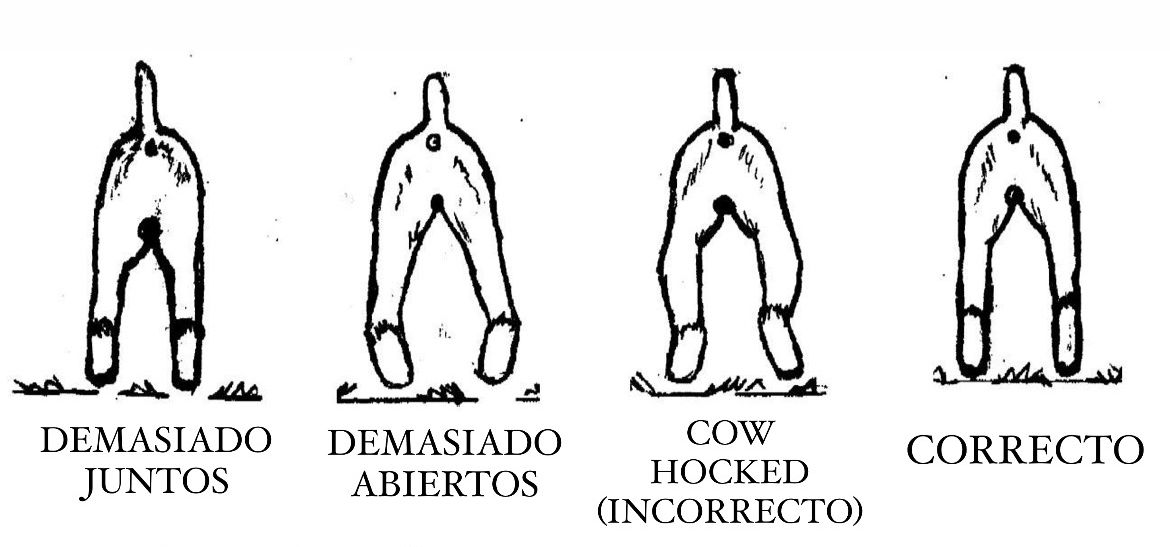
• Hindquarters: Should be muscular, with good angulation at the stifle joint and a strong, low hock.

FEET AND MOVEMENT OF THE JACK RUSSELL TERRIER
• Feet: Round, compact, with hard pads and strong nails.
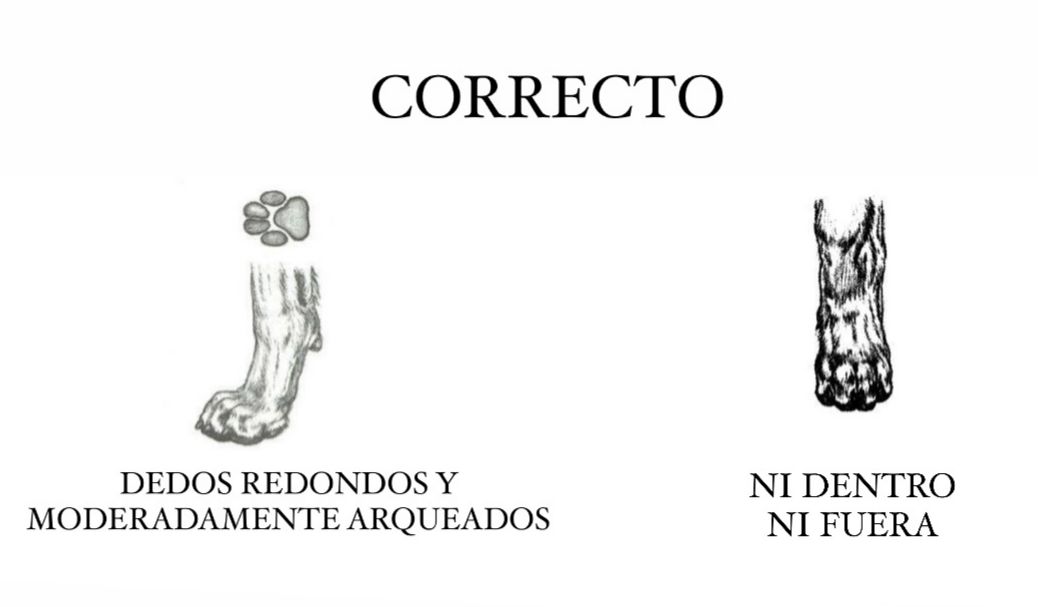
• Tail: May rest down when at rest. When moving, it should be upright.
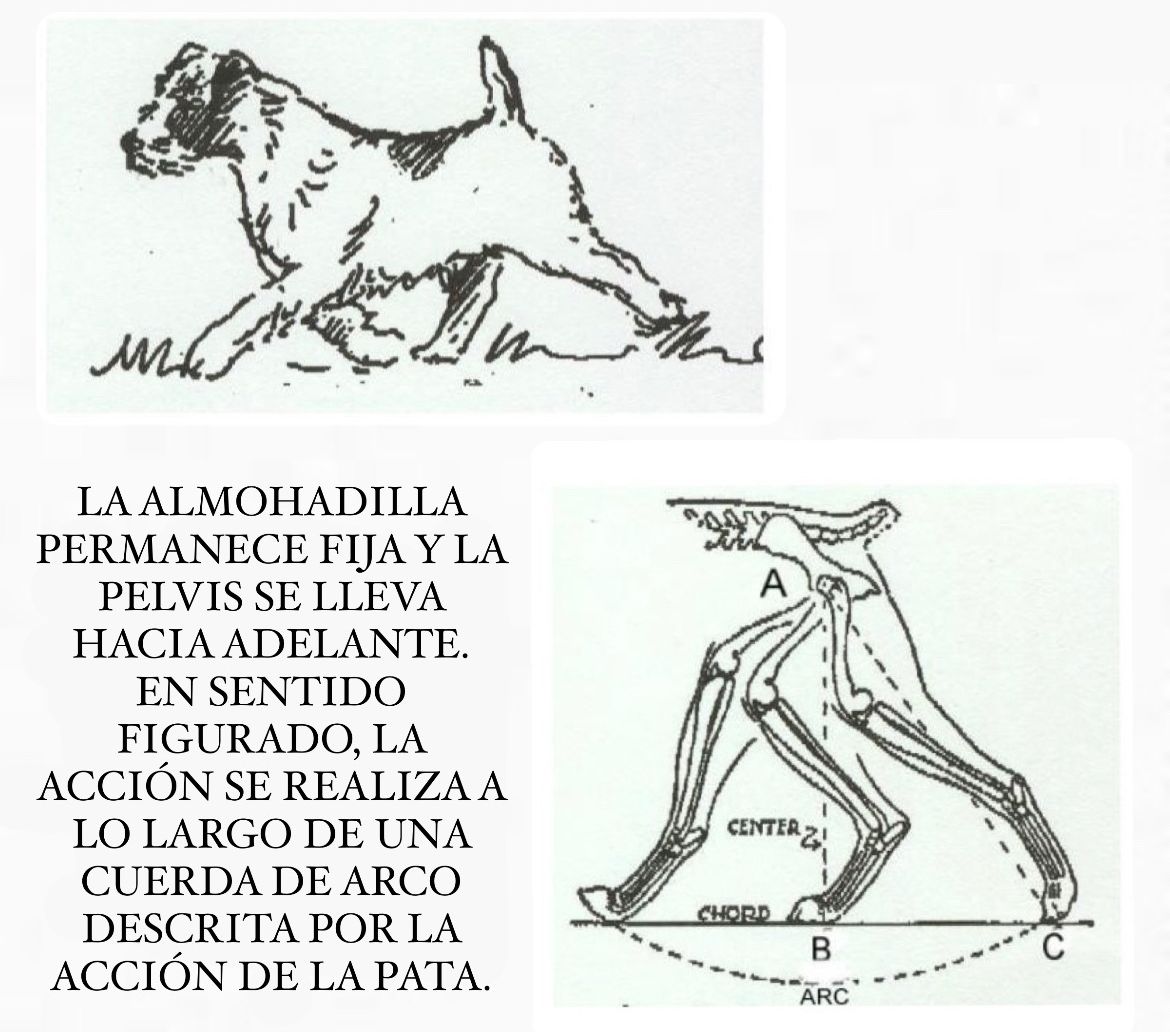
• Movement: Fluid and effortless, with good reach in the front and strong drive from behind.
COAT AND COLOR OF THE JACK RUSSELL TERRIER
• Texture: Varies between Smooth, Broken, or Rough (smooth, semi-hard, or hard, respectively) but always dense and water-resistant.
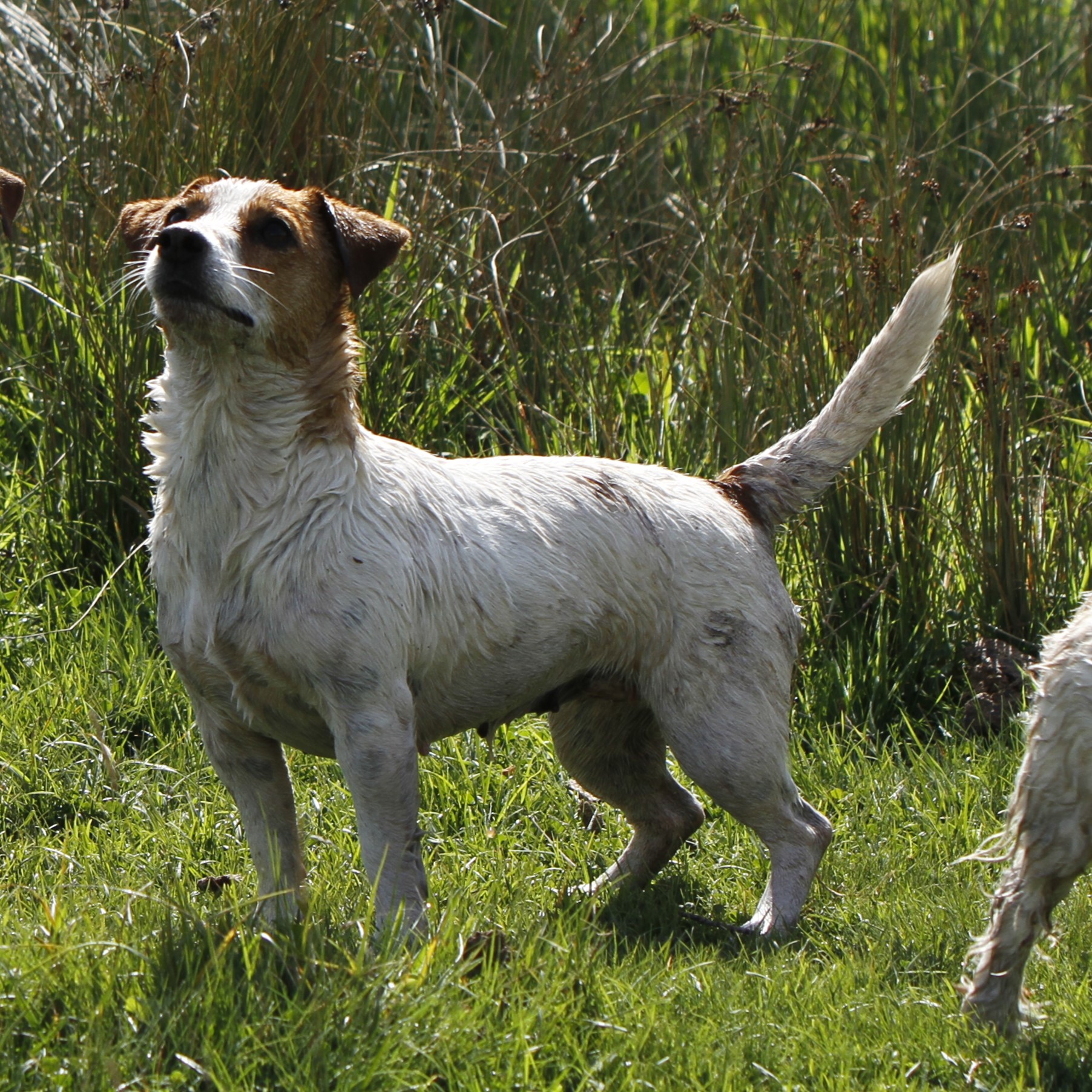
Smooth Coat (Liso)
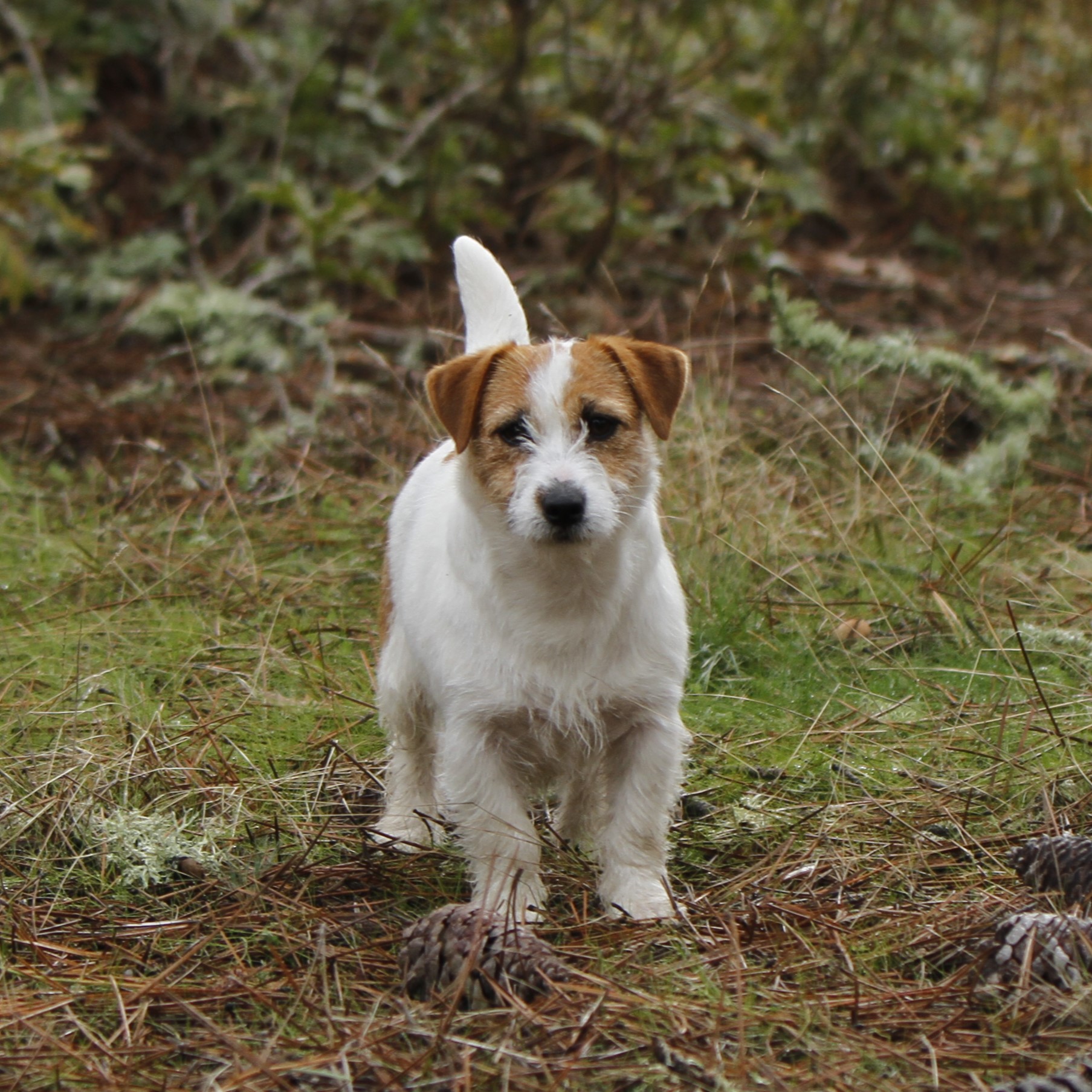
Broken Coat (Semi-hard)
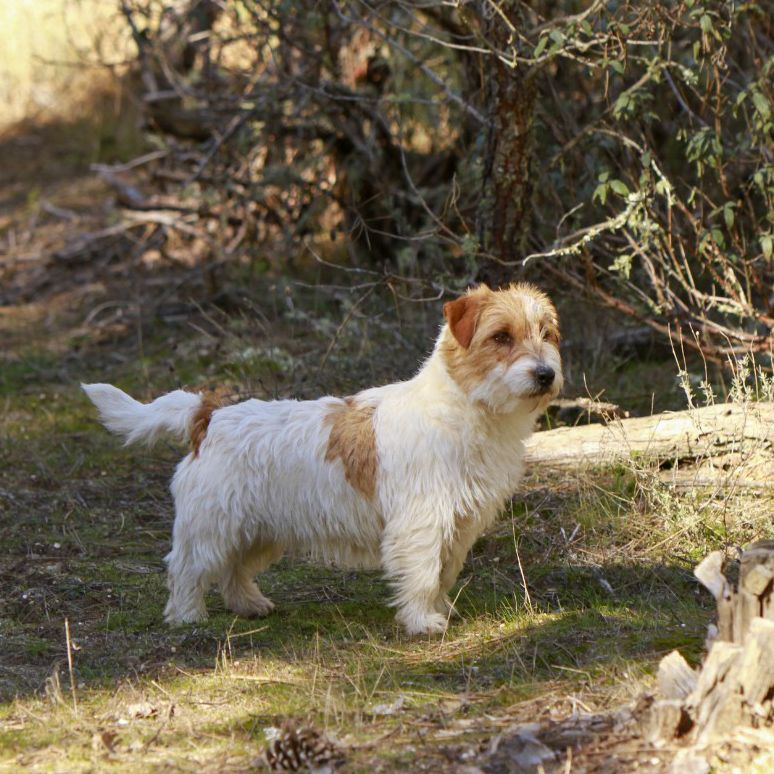
Rough Coat (Hard) Untidy

Rough Coat (Hard) Trimmed
• Color: Predominantly white, with black, brown, or tan markings.
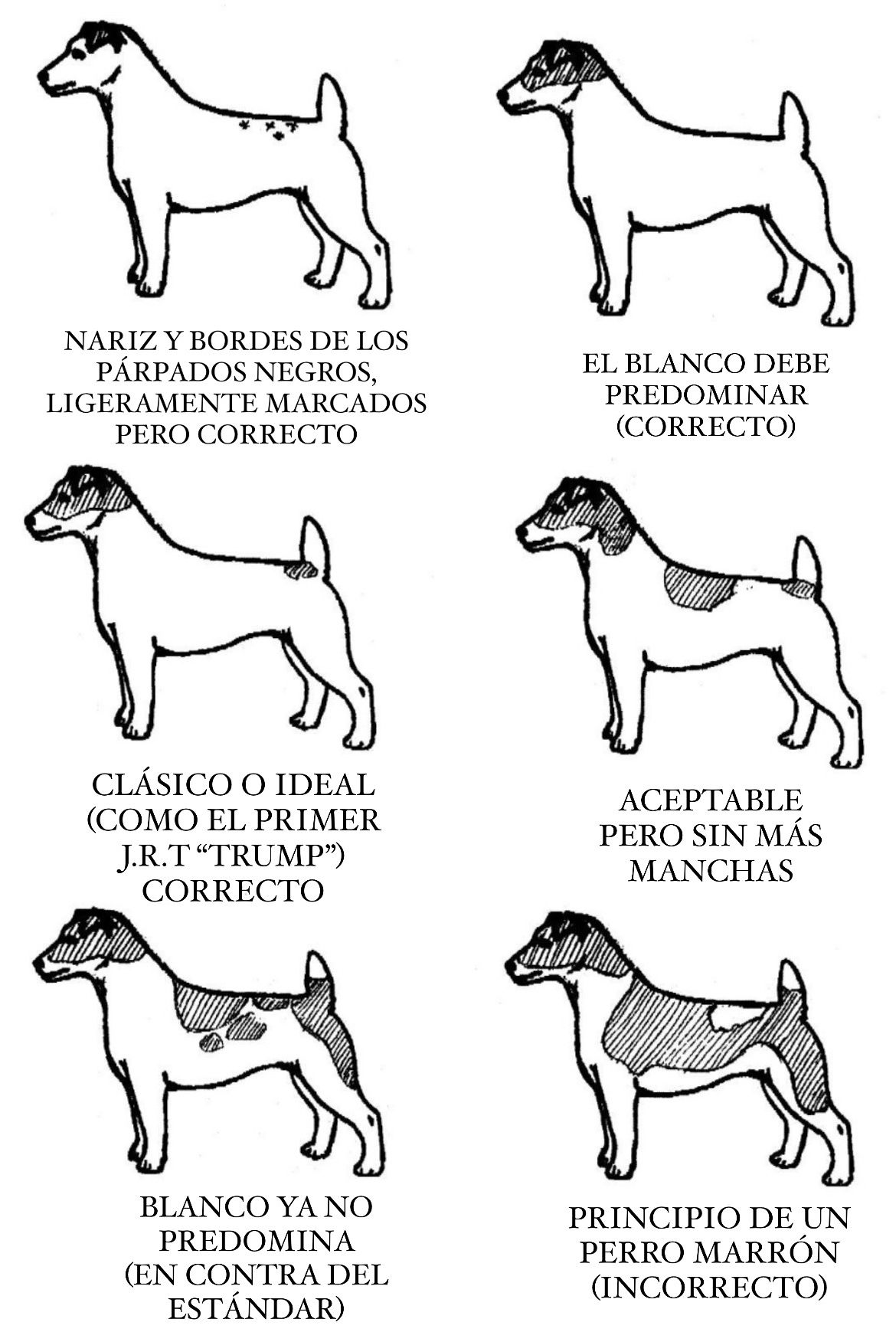
The maintenance and care of the Jack Russell Terrier’s coat varies depending on the type of hair it has. Dogs with rough or semi-rough hair require more meticulous care compared to those with smooth hair.
In general, smooth-coated dogs only need to be brushed once a week. On the other hand, Jack Russell Terriers with rough and semi-rough coats need to undergo a process known as stripping. This technique involves manually removing the old hair from the root, carried out mainly in spring—to remove the winter coat—as well as at the end of summer—to allow the growth of the winter coat that keeps the dog warm during the cold months.
By removing the dead hair in this way, its regeneration is facilitated, maintaining the texture and function of the coat. If the dog participates in dog shows, it will be necessary to follow a specific schedule to maintain its coat according to the required standards
PEDIGREE OF THE JACK RUSSELL TERRIER
The purity of the breed is essential to maintain the desirable characteristics of the Jack Russell Terrier. Pedigree records ensure that breed standards are maintained, tracing the dog’s genealogy to guarantee its lineage.
HEALTH OF THE JACK RUSSELL TERRIER
In general, the Jack Russell Terrier is a healthy, energetic, and lively dog. However, as a descendant of the Fox Terrier, this breed has a predisposition to develop conditions such as Ataxia and Terrier Myelopathy, also known as hereditary Ataxia, which affect its locomotor system. This rare hereditary disease tends to manifest in the first months of life and is associated with movement coordination disorders and, in some cases, hearing loss.
Additionally, Jack Russell Terriers may be prone to eye problems, such as lens luxation.
To minimize these risks, it is essential that responsible breeders carry out crossings exclusively between specimens whose pedigree is well documented and rigorously certified. Males and females intended for breeding must undergo medical evaluations to ensure they are free of these conditions.
As for life expectancy, the average lifespan of a Jack Russell Terrier is approximately 14 years.
CONCLUSION
The Jack Russell Terrier is, ultimately, a complete package: it combines courage, intelligence, loyalty, and charm. It is a small dog breed, but with a robust and athletic appearance. It also displays a well-developed muscular structure and a solid stance. This standard, carefully refined over the years, ensures that the breed maintains its integrity and continues to be the iconic terrier that so many people have loved and appreciated.
MORE INFORMATION
If you want to know more about this incredible breed, you can learn in detail about the Official Standard of the Jack Russell Terrier, established by the Fédération Cynologique Internationale, by clicking on the following link:
https://www.fci.be/nomenclature/Standards/345g03-es.pdf
On many occasions, the Jack Russell Terrier is mistaken for a different but similar breed: the Parson Russell Terrier. Many people identify them as the same breed, the Jack Russell Terrier, but distinguish them as “long-legged” or “short-legged.” The truth is that they are two totally different breeds, recognized and clearly differentiated and defined by the Fédération Cynologique Internationale.
If you want to see the differences between one breed and the other, in addition to learning about the Standard of the Jack Russell Terrier, check the Official Standard of the Parson Russell Terrier by clicking on the following link:
https://www.fci.be/Nomenclature/Standards/339g03-es.pdf
To delve deeper into the breed standard, two documents are attached: one concerning the Extended Standard of the Jack Russell Terrier, prepared by the Australian National Kennel Council (ANKC), which was the first to officially recognize this breed in 1991, and another on the Study of the Jack Russell Terrier, carried out by Mrs. R.N. Francis-Little.
 English (UK)
  Español